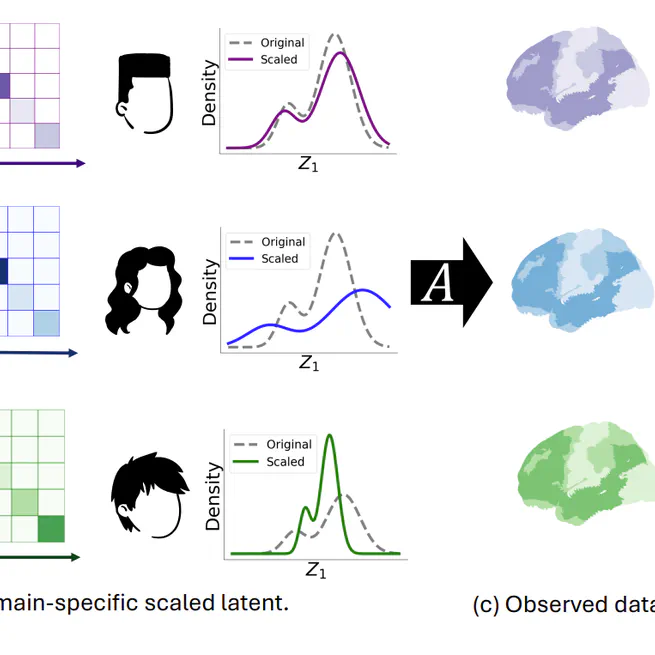
Identifying dependent components from multi-domain linear mixtures
May 1, 2026
Identifiability of Potentially Degenerate Gaussian Mixture Models With Piecewise Affine Mixing
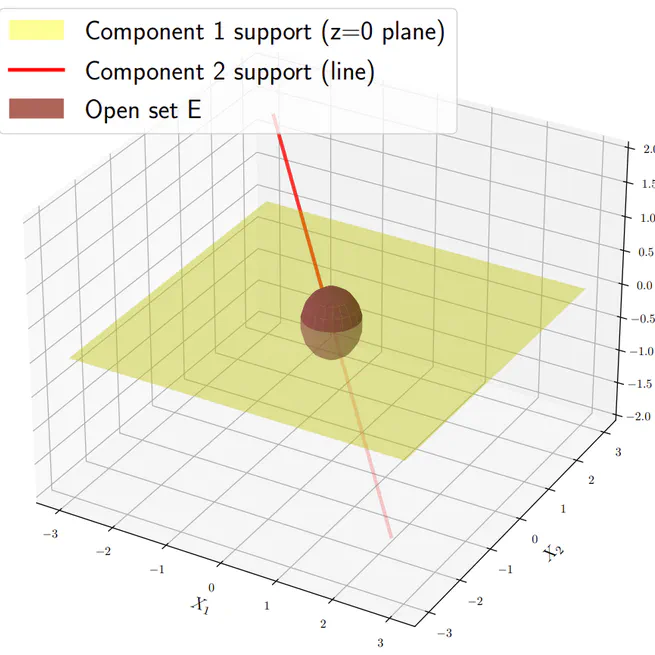
Causal representation learning (CRL) aims at identifying high-level causal variables from perceptual data. Most methods assume a full-rank latent space. However, in many real-world settings, mixtures of low-dimensional subspaces provide a more accurate model than full-rank representations. To model the low-rank latent space, we focus on potentially degenerate Gaussian mixture models (pdGMMs). We provide a series of identifiability results for recovering latent variables following a pdGMM distribution from observations, up to - affine transformation within components (ATwC), - global affine transformation (AT), - permutation and scaling (PS)
Jan 15, 2026
A sparsity principle for partially observable causal representation learning
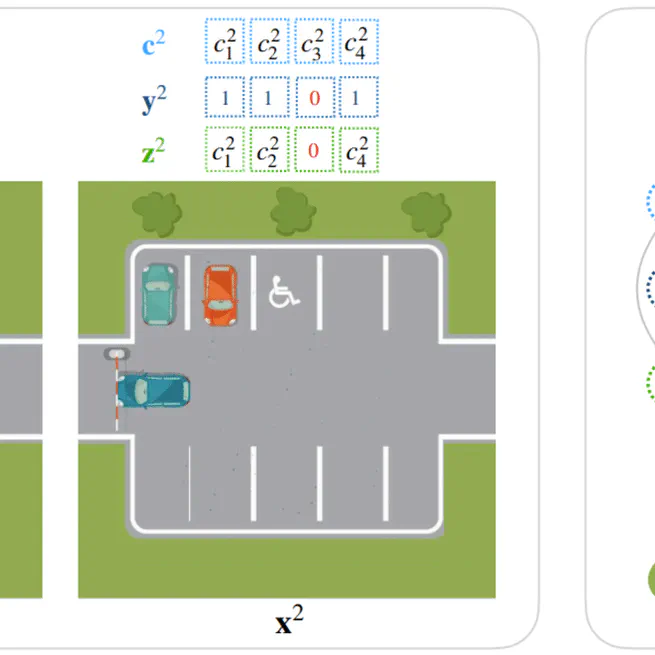
Most CRL methods assume that all latent causal variables are captured in the high-dimensional observations. We instead consider a partially observed setting, in which each measurement only provides information about a subset of the underlying causal state. Here we focus on learning from unpaired observations from a dataset with an instance-dependent partial observability pattern. Our main contribution is to establish two identifiability results for this setting':' one for linear mixing functions without parametric assumptions on the underlying causal model, and one for piecewise linear mixing functions with Gaussian latent causal variables.
May 1, 2024
Multi-view causal representation learning with partial observability
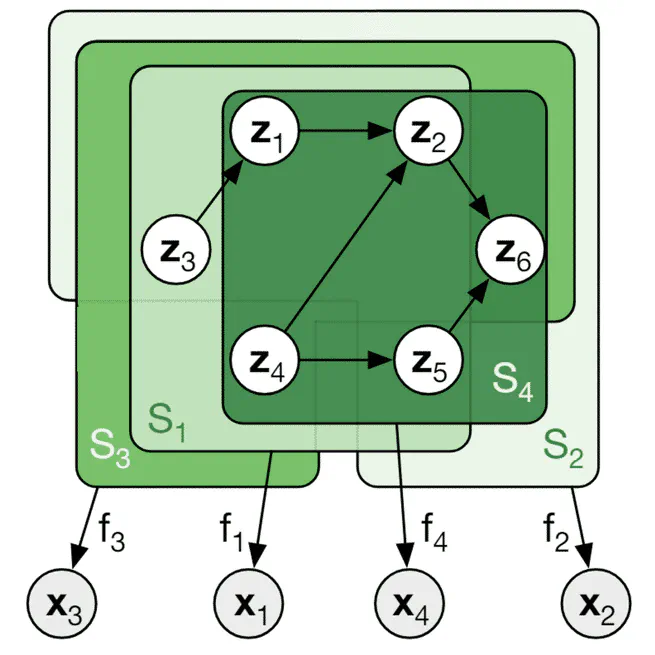
We present a unified framework for studying the identifiability of representations learned from simultaneously observed views, such as different data modalities. We allow a partially observed setting in which each view constitutes a nonlinear mixture of a subset of underlying latent variables, which can be causally related. We prove that the information shared across all subsets of any number of views can be learned up to a smooth bijection using contrastive learning and a single encoder per view.
Jan 15, 2024